
Understand how debt consolidation works and whether it may suit your financial situation.
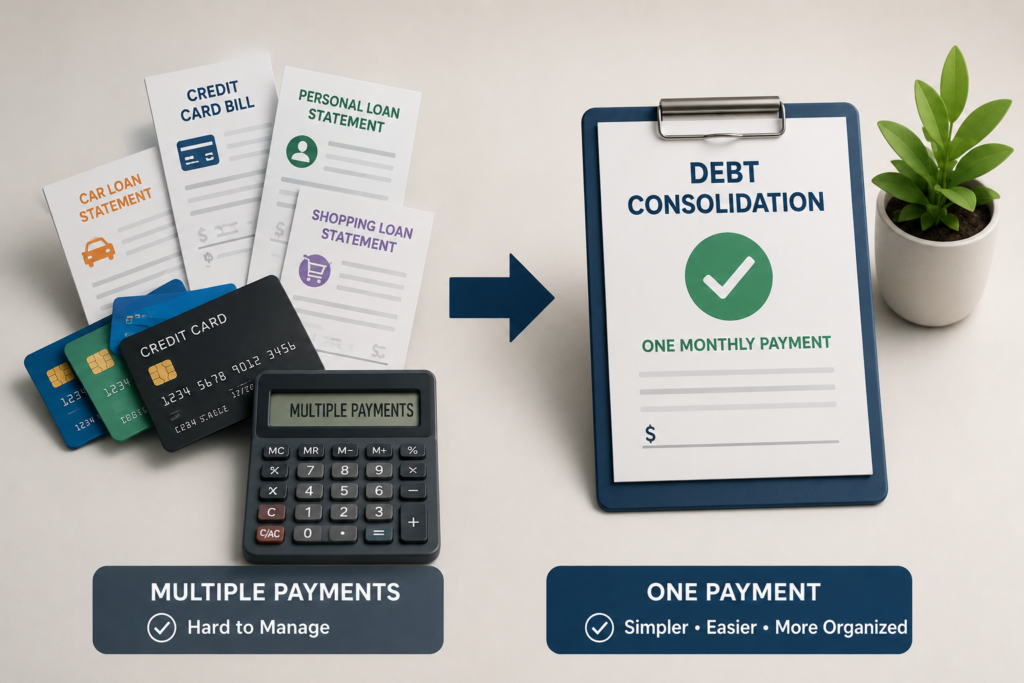
Managing several monthly repayments at the same time can become challenging.
One repayment is due at the beginning of the month.
Another is due a week later.
Credit card statements arrive on different dates, while personal financing and vehicle repayments continue every month.
Over time, keeping track of multiple payment schedules can become stressful.
If you’ve ever wondered whether there is a simpler way to organise your financial commitments, you’ve probably come across the term Debt Consolidation.
Although it is widely discussed, many people are still unsure what it actually means.
Some believe debt consolidation eliminates debt completely, while others think it is only suitable for people experiencing serious financial difficulties.
In reality, debt consolidation is simply one financial strategy that may help certain individuals organise existing financial commitments more effectively, depending on their circumstances.
Understanding how it works allows you to decide whether it is something worth considering.
Quick Take
Before considering debt consolidation, remember:
- Debt consolidation combines eligible financial commitments into a new financing arrangement.
- It does not remove or erase existing debt.
- The objective is often to simplify repayments.
- Every individual’s financial circumstances are different.
- Understanding the overall repayment structure is just as important as understanding the monthly repayment.
What Is Debt Consolidation?
Debt consolidation refers to combining multiple eligible financial commitments into a single financing arrangement.
Instead of managing several repayments every month, some borrowers choose to consolidate them into one repayment schedule.
The primary objective is often to simplify financial management rather than eliminate debt.
Debt consolidation may be considered by individuals who want a clearer overview of their monthly financial commitments.
Why Do People Consider Debt Consolidation?
Different people have different financial goals.
Some choose debt consolidation because they want:
- – One monthly repayment instead of several
- – Better organization of their monthly finances
- – A simpler repayment schedule
- – Improved visibility of their financial commitments
The reasons vary from person to person, and debt consolidation is not a one-size-fits-all solution.
Example
Jason currently manages:
- One personal financing
- Two credit cards with outstanding balances
- Vehicle financing
Each repayment has a different due date.
Although Jason has been making his repayments, he finds it increasingly difficult to keep track of multiple payment schedules. Before making any financial decision, he reviews his existing commitments and seeks professional advice to better understand whether debt consolidation is suitable for his circumstances.
What Should You Consider Before Choosing Debt Consolidation?
Debt consolidation should never be viewed as an automatic solution.
Before making a decision, it is important to understand the complete financing structure.
Consider reviewing:
Your Total Repayment Amount
A lower monthly repayment does not necessarily mean the total repayment amount will be lower.
Understanding the overall financing cost is equally important.
Financing Tenure
A longer financing tenure may reduce monthly repayments, but it could also increase the overall financing cost.
Finding a balance between affordability and long-term cost is essential.
Existing Financial Commitments
Take time to review your current commitments before deciding whether consolidation aligns with your financial goals.
Financial Discipline
Debt consolidation works best when accompanied by responsible financial habits.
Continuing to accumulate unnecessary debt after consolidation may create additional financial pressure in the future.
Common Misunderstandings About Debt Consolidation
“Debt consolidation removes my debt.”
No. Debt consolidation reorganizes eligible financial commitments into a new financing arrangement.
The responsibility to repay remains.
“Debt consolidation is only for people with financial problems.”
Not necessarily.
Some individuals choose debt consolidation simply because they prefer a more organised repayment structure.
“Lower monthly repayments always mean lower costs.”
Not always.
A lower monthly repayment may result from extending the financing period. This is why reviewing the total repayment amount remains important.
Key Takeaways
Before considering debt consolidation, remember:
- Understand your current financial commitments.
- Compare the total repayment amount, not just the monthly repayment.
- Consider the financing tenure carefully.
- Debt consolidation simplifies repayments but does not eliminate debt.
- Choose a financial solution that supports your long-term financial wellbeing.
1. What is debt consolidation?
Debt consolidation combines eligible financial commitments into a single financing arrangement, making repayments easier to manage.
2. Is debt consolidation suitable for everyone?
Not necessarily. The suitability of debt consolidation depends on an individual’s financial circumstances, repayment ability, and financial goals.
3. How can Client Connect Advisory help?
Client Connect Advisory provides advisory services to help clients understand available financing solutions, review their financial circumstances, and make informed financing decisions based on their individual needs.