
Compare both interest calculations and make more informed financing decisions.

Imagine you’re comparing two financing offers.
The first advertises an interest rate of 3.50%, while the second shows 6.20%.
At first glance, the choice seems obvious. Most people naturally assume that the lower rate must be the better option.
However, financing doesn’t always work that way.
One important detail that many borrowers overlook is how the interest is calculated. Two financing products may display very different interest rates, yet the total cost over the financing period can be much closer than expected.
This is where understanding the difference between Flat Interest Rate and Effective Interest Rate becomes valuable.
Knowing the difference allows you to compare financing options more accurately instead of focusing only on the percentage shown in an advertisement.
Quick Take
Before comparing financing options, remember these key points:
- A lower advertised interest rate does not always mean lower overall financing costs.
- Flat Interest Rate and Effective Interest Rate are calculated differently.
- Monthly repayments are only one part of the comparison.
- Always understand the total repayment amount before making a decision.
- Comparing financing products fairly requires looking beyond the headline interest rate.
Why Do Different Financing Products Show Different Interest Rates?
One of the most common misunderstandings is believing that all interest rates are calculated using the same method.
In reality, different financing products may use different interest calculation methods.
This is why comparing a Flat Interest Rate directly with an Effective Interest Rate may not provide a complete picture.
Understanding which calculation method is being used is just as important as knowing the interest rate itself.
What Is a Flat Interest Rate?
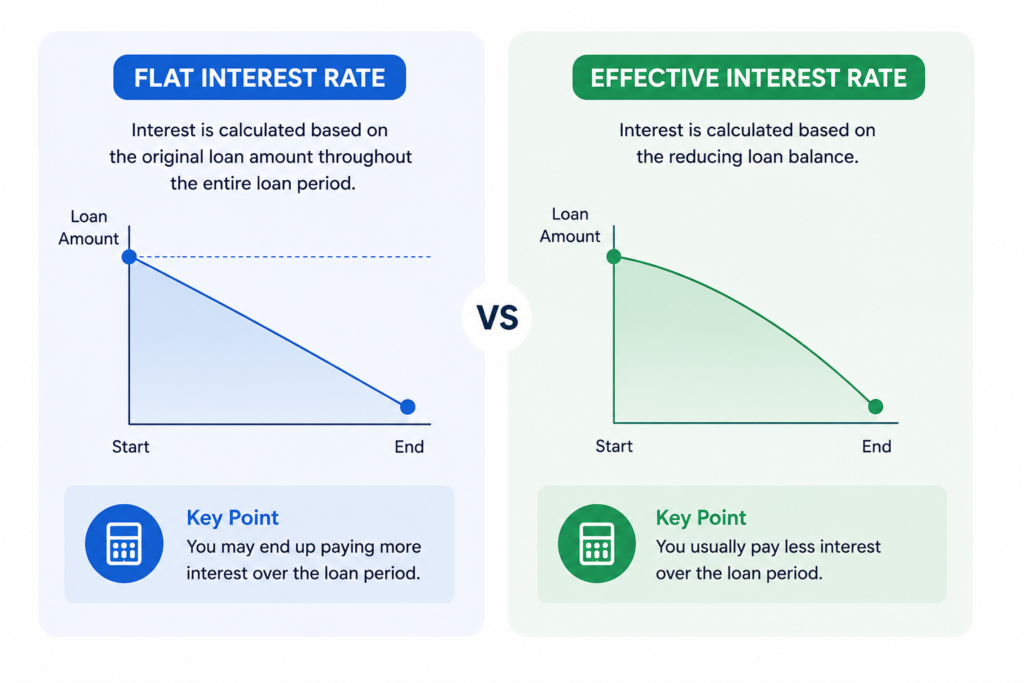
A Flat Interest Rate calculates interest based on the original financing amount throughout the entire financing period.
Even though your outstanding balance gradually decreases as you make repayments, the interest calculation continues to use the original financing amount.
As a result, the advertised Flat Interest Rate often appears lower than an Effective Interest Rate.
However, this does not necessarily mean the financing is less expensive overall.
Example
Emily applies for a financing facility of RM50,000 with a Flat Interest Rate.
Throughout the financing period, the interest is calculated using the original RM50,000 rather than the remaining balance after each monthly repayment.
Although the advertised rate looks attractive, it should not be compared directly with products that use a different calculation method.
What Is an Effective Interest Rate?
An Effective Interest Rate, also known as a reducing balance rate, calculates interest based on the remaining outstanding balance.
As repayments are made, the outstanding balance becomes smaller.
Because the interest is calculated on the remaining balance, the amount of interest charged generally reduces over time.
This calculation method is commonly associated with financing products where the outstanding balance decreases after every repayment.
Example
Daniel chooses a financing product that uses an Effective Interest Rate.
After each monthly repayment, the remaining balance becomes lower, and future interest calculations are based on that reduced amount rather than the original financing amount.
Why You Shouldn’t Compare the Numbers Alone
Suppose you receive two financing quotations.
Option A shows:
3.50% Flat Interest Rate
Option B shows:
6.20% Effective Interest Rate
Many people immediately assume Option A is cheaper simply because the number is lower.
However, because the interest is calculated differently, comparing the percentages alone may not provide an accurate comparison.
Instead, it is more helpful to review:
- Monthly repayment
- Total repayment amount
- Financing tenure
- Interest calculation method
- Any applicable fees and charges
Looking at the overall financing structure provides a much clearer basis for comparison.
What Else Should You Compare Besides Interest Rates?
Interest rates are important, but they are only one part of the decision-making process.
Before choosing a financing solution, consider reviewing:
Monthly Repayment
Will the repayment comfortably fit within your monthly budget?
Total Financing Cost
How much will you repay over the entire financing period?
Financing Tenure
A longer tenure may reduce monthly repayments but could increase the total financing cost.
Early Settlement Terms
If you intend to settle the financing earlier than planned, it is worth understanding whether any terms or conditions apply.
Your Financial Goals
The most suitable financing solution is not always the one with the lowest advertised interest rate.
It should also align with your financial needs, repayment ability, and long-term plans.
Common Misunderstandings About Interest Rates
“A lower interest rate always means a better deal.”
Not necessarily. Different calculation methods can produce different advertised rates, making direct comparisons misleading.
“I only need to compare the monthly repayment.”
Monthly repayment is important, but understanding the total repayment amount over the financing period provides a more complete picture.
“All financing products calculate interest in the same way.”
Different financing products may use different calculation methods depending on the product structure and financing provider.
Understanding these differences helps you compare financing options more fairly.
Key Takeaways
Before comparing financing options, remember:
- Understand how the interest rate is calculated.
- Avoid comparing Flat and Effective Interest Rates directly.
- Review the total repayment amount, not just the advertised percentage.
- Consider your monthly repayment capacity.
- Choose a financing solution that supports your long-term financial plans
1. Why does a lower interest rate not always mean a lower financing cost?
A lower advertised rate may use a different calculation method. This is why two financing options with different interest rates may result in different overall repayment costs. Always understand how the interest is calculated before making a comparison.
2. Can I compare financing options based only on the monthly repayment?
No. While monthly repayment is an important consideration, it should not be the only factor when comparing financing options. It is also helpful to understand the interest calculation method, financing tenure, and the total repayment amount to gain a clearer picture of the overall financing cost..
3. How can Client Connect Advisory support my financing application?
We provide guidance throughout the financing application process, helping clients understand available financing options, organise the required documents, and prepare their applications. We do not provide, approve, or guarantee financing.